What will be the future charging needs?
What will be the future charging needs of cars and logistics vehicles? New modelling tool provides a better understanding of mobility behaviour.
Based on existing traffic and transportation models, Significance, in collaboration with ElaadNL, has developed a new tool that helps map the charging needs of electric vehicles in the Netherlands more accurately. The tool makes it possible to provide a more targeted estimate of charging needs for different types of vehicles.
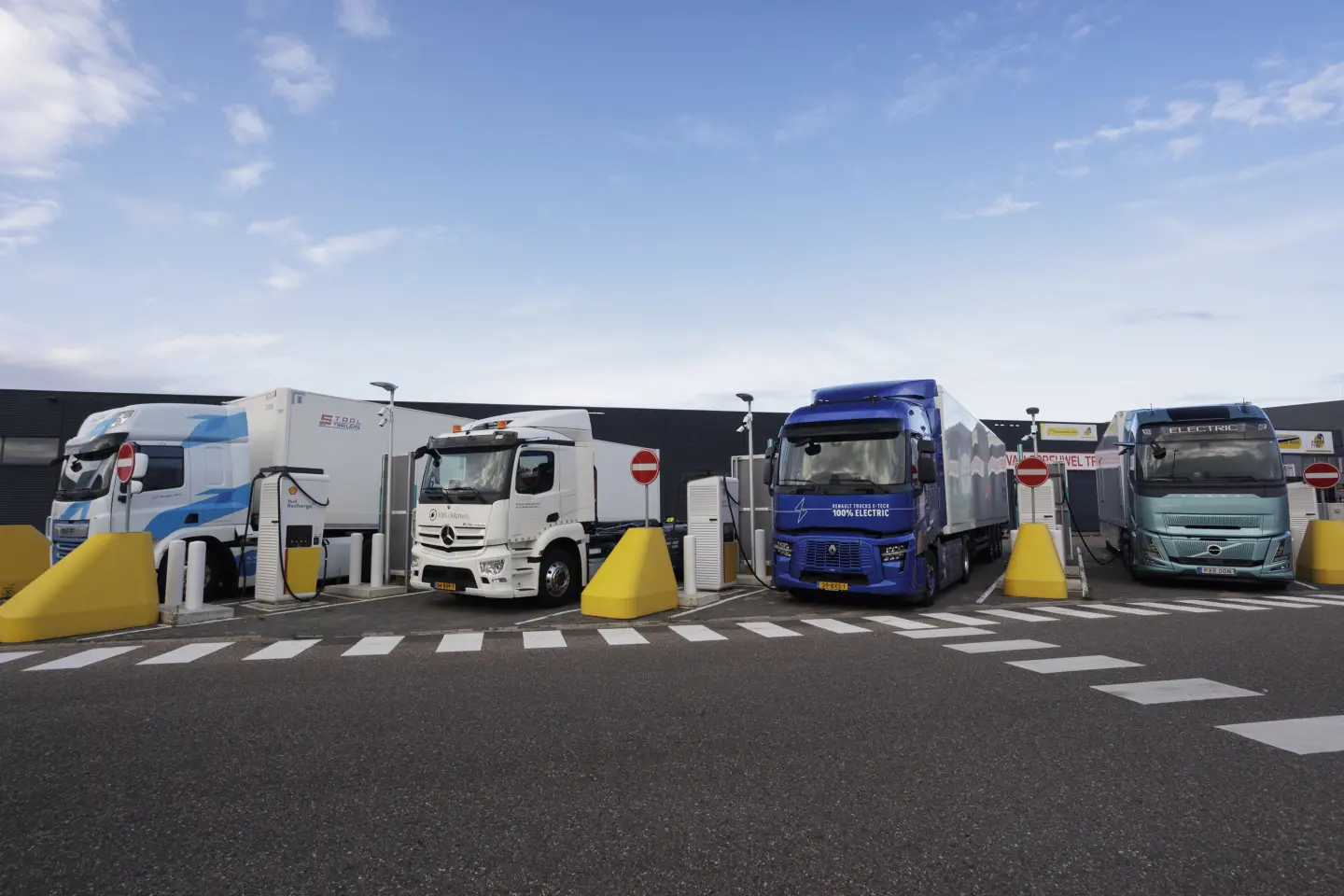
Photo: ElaadNL
ElaadNL periodically publishes Outlook reports, which look ahead to the expected growth of electric transportation and its implications for charging infrastructure and the power grid. These Outlook reports examine, among other things, charging infrastructure and its regional distribution. Key inputs for this include strategic traffic and transportation models, which provide insights into mobility behaviour.
Quote Nazir Refa(researcher ElaadNL): “Thanks to our collaboration with Significance, we have, for the first time, mapped the mobility behaviour of both passenger cars and logistics vehicles in a comprehensive and consistent manner. The flexibility of the modelling tool also makes it possible to implement adjustments more quickly and transparently. For example, we can focus specifically on the behaviour of private passenger cars or analyze specific segments within the logistics sector. Finally, this study also provides insight into the proportion of foreign freight vehicles at the regional level.”
For the new Outlook on Electric Mobility, ElaadNL collaborated with Significance. Together, we developed a modelling tool to generate more detailed forecasts of the mobility behaviour of passenger cars and logistics vehicles. The charging needs of these vehicles vary significantly by mode, location, and time. A detailed spatial and temporal forecast is therefore essential for providing substantiated and transparent input for the Mobility Outlook.
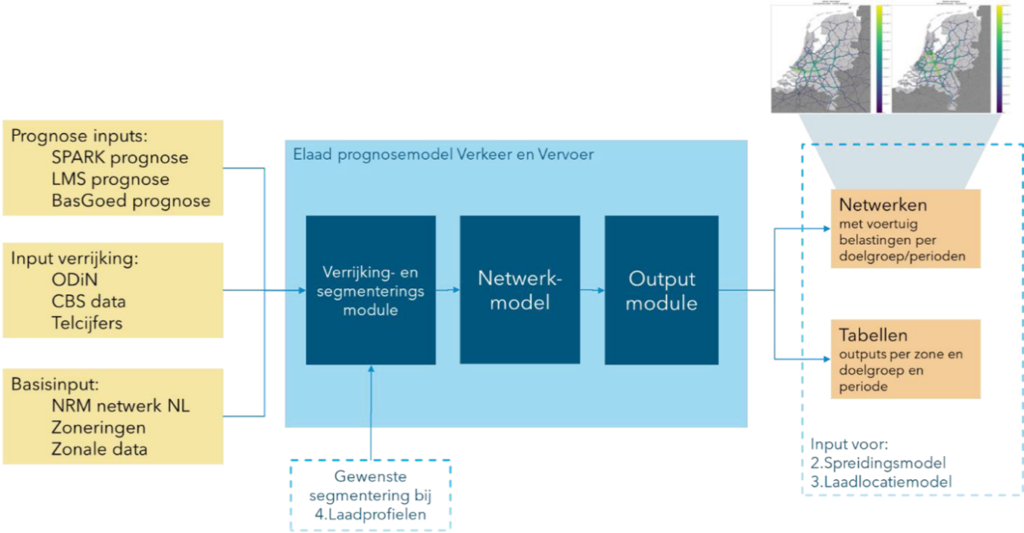
The model structure below shows which data sources and models were used as input for this modeling tool.
Quote Michiel de Bok (research leader Significance): “Meeting the future charging needs of all vehicles in the Netherlands is a massive challenge. ElaadNL is the leading expert in charging strategies and charging infrastructure. It’s a pleasure to collaborate based on our areas of expertise: this approach has allowed us to create added value through customized solutions, enabling a more accurate projection of future charging infrastructure for the Netherlands.”
Improvements in the new model
The model generates both detailed datasets and aggregated statistics on the mobility behaviour of various target groups or vehicle categories. These provide valuable insights into key indicators needed to estimate future charging demand.
The main improvements are:
- Logistics loading demand is analyzed at the route level rather than for individual trips from A to B. This provides a much more realistic basis for estimating loading demand along the route, since many logistics trips are planned as collection or distribution routes.
- The spatial dimensions of the traffic and transport forecast have been refined to the CBS neighborhood level so that they align with the classification used in network management planning.
- Insight into the proportion of trips made by foreign trucks by region.
- Improved insight into vehicle movements, including the number of stops, at logistics hubs such as ports.
- The intensity of truck traffic on the road network has been calculated for a time profile throughout the day.
- The kilometers traveled by passenger cars have been refined to the neighborhood level and broken down by private and personal car ownership.
In addition, the model is now designed to be much more efficient, enabling significantly faster and more consistent work. This optimization makes it possible to test various hypotheses and assumptions about future charging behaviour more quickly. This results in a much more accurate and practical understanding of where and when charging demand arises and what kind of deployment and expansion of charging infrastructure is appropriate.
ElaadNL incorporates the insights from this model into various sections of the Electric Mobility Outlook. In addition, the model has been delivered as ready-to-use source code. This allows ElaadNL to continue working independently on the further development and improvement of the tool.
Outlook Mobility
In collaboration with the National Charging Infrastructure Agenda (NAL), ElaadNL is currently developing the first comprehensive Outlook Mobility, which will be presented on June 9. The NAL regions, the Ministry of Infrastructure and Water Management, and the grid operators are involved in the implementation and validation of the study.